
Democracy in Canada
Does the purpose of an election debate be to reflect the polls or to allow voters to get to know the candidates?

Democracy is made up of a set of institutions, rules, and procedures that go far beyond the act of voting. In this series, "Democracies Around the World," High-TechSociety presents experiences adopted by different countries to address specific challenges of the democratic process. Topics already covered include the democratic selection of candidates by political parties, protecting the formation of voter will in the face of the dissemination of electoral polls, and transparency in voting and vote counting.
In this article, the series examines another fundamental aspect of democracy: who establishes and what are the criteria for choosing the candidates who will participate in electoral debates?
Election debates occupy a prominent place in campaigns for executive branch positions. In many countries, they represent the main opportunity for millions of voters to directly compare the candidates' proposals, preparation, argumentation skills, and vision for governance.
However, even before the debate begins, a question arises that often goes unnoticed:
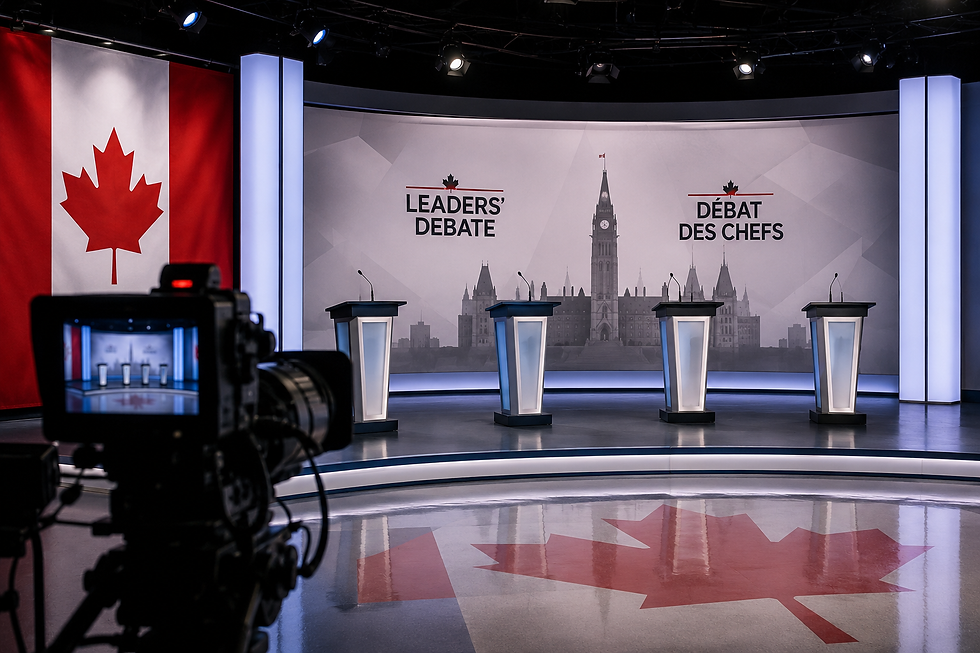
Who should participate in the debates?
At first glance, the answer seems simple. After all, if the goal is to bring together the candidates with the best chances of winning, it would be enough to invite those who are leading in the polls.
But this solution leads to a democratic dilemma: if debates exist so that voters can get to know the candidates better, wouldn't using polls to determine who can participate further increase the advantage of those who are already better known?
In other words: Should the debate reflect the polls or allow voters to get to know the candidates?
This question reveals an institutional challenge faced by many democracies: how to preserve the quality of debates without preventing new leaders from having the opportunity to present their proposals to the electorate?
The dilemma between quality and equal opportunities.
Allowing all candidates to participate in debates can, under certain circumstances, make them excessively long, hinder in-depth discussion of the topics, and reduce audience attention.
On the other hand, excessively restricting participation could concentrate public exposure only on candidates who already have greater political visibility, making it difficult for new leaders to gain voter recognition.
The question, therefore, is not simply about deciding who should participate in the debates.
It consists, above all, of defining who should establish the criteria for this choice .
When this decision remains exclusively in the hands of television networks, private organizers, or even election polls , questions arise about the impartiality of the process.
It was precisely to meet this challenge that Canada developed a unique institutional model within the parliamentary system.
Unlike presidential systems, where voters directly choose the head of the Executive Branch, in Canada they do not vote directly for Prime Minister.
Voters elect members of the House of Commons. After the election, the leader of the party that obtains the support of a parliamentary majority is invited by the Governor-General – the representative of the Head of State – to form the government and serve as Prime Minister. During the election campaign, the leaders of the main parties present their government programs and become, in the eyes of the electorate, the candidates for the position of Prime Minister. It is between these leaders that national debates take place.
The emergence of an institutional solution
For many years, Canadian federal debates were organized through negotiations between media outlets and political parties.
This model began to receive criticism. Among other aspects, the lack of permanent criteria for defining which leaders would participate in the debates was questioned, as well as the possibility of different decisions being adopted in each election.
In response to these concerns, the Government of Canada established the Leaders Debates Commission in 2018, which was subsequently strengthened in its institutional mandate. Its goal was not simply to organize debates. The proposal was far more ambitious: to transform national debates into a permanent institution of the Canadian democratic process, based on predictable, transparent rules independent of the political negotiations that take place during each election campaign.
This represents an important shift in perspective. Instead of simply discussing who participates in the debates , Canada has moved on to discussing how the criteria that define this participation should be constructed .
An independent commission
The Commission operates independently of the government and political parties.
Her mandate includes organizing two national debates in each federal election—one in English and one in French. She also establishes the criteria for participation by party leaders and ensures broad public accessibility, among other responsibilities.
How were the participation criteria established?
For the 2025 national debates, the Commission established criteria focused on simplicity, objectivity, transparency, verification, and compatibility with the public interest. Furthermore, the Commission sought to avoid any single factor determining participation in the debates.
In its assessment, the Commission considered that both relying exclusively on election polls and automatically admitting all candidates presented significant limitations.
The solution found was to combine different indicators of representativeness and electoral viability.
Criteria that seek to balance representativeness and feasibility.
To participate in the national debates, a party leader had to meet at least two of three criteria previously established by the Commission.
The first criterion was having parliamentary representation , that is, leading a party that already had at least one member elected to the House of Commons on the date the election was called.
The second criterion considered current electoral viability . For this, the party needed to achieve at least 4% of national voting intentions , measured by the average of the main public polls conducted approximately four weeks before the election. The Commission did not limit itself to accepting just any statistical survey. The polls used were selected considering aspects such as methodology, national scope, credibility of the institutes, and recency of the data.
The third criterion sought to demonstrate the effective capacity to contest a national election. The party had to field candidates in at least 90% of the federal electoral districts . The goal was to distinguish parties with a truly national reach from those whose electoral presence remained limited to certain regions or whose participation in the election was only partial.
The Commission opted not to require simultaneous fulfillment of all three requirements. It was sufficient for the leader to satisfy two of the three criteria. This solution sought to avoid both excessive rigidity and flexibility that could compromise the quality of the debates.
None of the criteria, in isolation, was considered sufficient to demonstrate that a particular candidacy should necessarily participate in the national debates. It was precisely the combination of them that the Commission considered capable of producing a more balanced result.
The institutional logic deserves emphasis.
The logic behind this combination deserves highlighting. A newly created party may not yet have parliamentary representation, but demonstrate electoral viability by achieving at least 4% of voting intentions and presenting candidates in more than 90% of federal electoral districts. Similarly, a party already represented in the House of Commons may remain eligible to participate in debates even without reaching the 4% threshold in polls, provided it maintains parliamentary representation and national reach , evidenced by presenting candidates in at least 90% of federal electoral districts.
By combining different indicators, the model seeks to prevent a single criterion from determining, in isolation, who will have access to the main space for presenting proposals to the electorate.
The effectiveness of the rules
A legal norm only acquires full credibility when it demonstrates the ability to produce concrete effects.
In the 2025 federal elections, the Commission had to deal with a situation that put its own criteria to the test.
Following an initial assessment, a political party had been deemed eligible to participate in the debates. However, after the official deadline for candidate registration, it was found that the party no longer met one of the previously established requirements to demonstrate its national competitive capacity.
Given this new scenario, the Commission reassessed its decision and revoked the previously issued invitation .
Regardless of opinions on the merits of the decision, the episode revealed an important aspect of the Canadian model: the previously disclosed criteria were effectively applied, even when this required modifying a decision that had already been announced.
More important than the specific case is the institutional message conveyed to the voter: the rules did not remain merely on paper.
An institution that seeks to learn continuously.
Perhaps the most interesting aspect of the Canadian experience lies not so much in the criteria adopted, but in the way they evolve.
After each federal election, the Commission conducts a comprehensive institutional evaluation process.
The debates are analyzed from various perspectives, including organization, format, participation criteria, moderation, accessibility, transmission, and audience reach.
Next, it holds consultations with political parties, experts, researchers, communication professionals, and representatives of civil society.
The findings are compiled into an official report submitted to the Canadian Parliament, containing recommendations aimed at improving the model for future elections.
This practice demonstrates a particularly interesting conception of democracy.
Instead of considering established rules as definitive, the system assumes that public institutions can learn from accumulated experience and continuously improve their own operating mechanisms.
High-Tech Society - Analysis
By removing the choice of debate participants—from negotiations between political parties and media outlets—and assigning it to an independent commission that operates with public criteria, expert consultations, and accountability to Parliament, Canada seeks to make this process more transparent, predictable, and institutional.
Naturally, no model completely eliminates controversies.
There will always be room to discuss whether a certain percentage of polls should be higher or lower, whether the requirement of candidates in 90% of districts represents the most appropriate equilibrium point, or whether other criteria could produce different results.
These disagreements are inherent to democracies.
However, perhaps the most relevant aspect is not the choice of a specific criterion, but the method used to construct it.
The Canadian model offers a reflection that goes beyond the organization of electoral debates. Its main merit, perhaps, lies not in the criteria adopted, but in the way it addressed a complex institutional issue , which requires a balanced solution to reconcile different democratic objectives, transforming it into a permanent institutional procedure based on previously known rules, public consultations, technical justification, and continuous review.
Trust in the Commission responsible for organizing national televised debates, which reach a large audience and have a significant impact on the electorate, is built through ongoing institutional consultations with the various actors involved in the electoral process and the uniform application of pre-established criteria .
Furthermore, the model is based on the recognition that political dynamics are constantly changing . For this reason, the Commission promotes the constant improvement of its rules, seeking to offer voters increasingly representative, balanced, and useful debates for forming their opinions.
By Luiz Cincurá
Founder and Editor
Editorial transparency: This article was produced with the support of ChatGPT during the research and preliminary content organization stages. The definition of the editorial approach, critical analysis, technical review, and final writing were carried out by the Editor, who is ultimately responsible for the published content.
Sources:
Government of Canada. Leaders' Debates Commission .
Leaders' Debates Commission. Mandate .
Leaders' Debates Commission. Participation Criteria for the Next Leaders Debates (2025).
Leaders' Debates Commission. Polling Methodology.
Leaders' Debates Commission. Decision concerning the participation of a political party in the 2025 Leaders' Debates.
Leaders Debates Commission. Report 2025.
Parliament of Canada. Majority and Minority Governments.


Comments